
Recent Events Reported by Observers
Previous Next
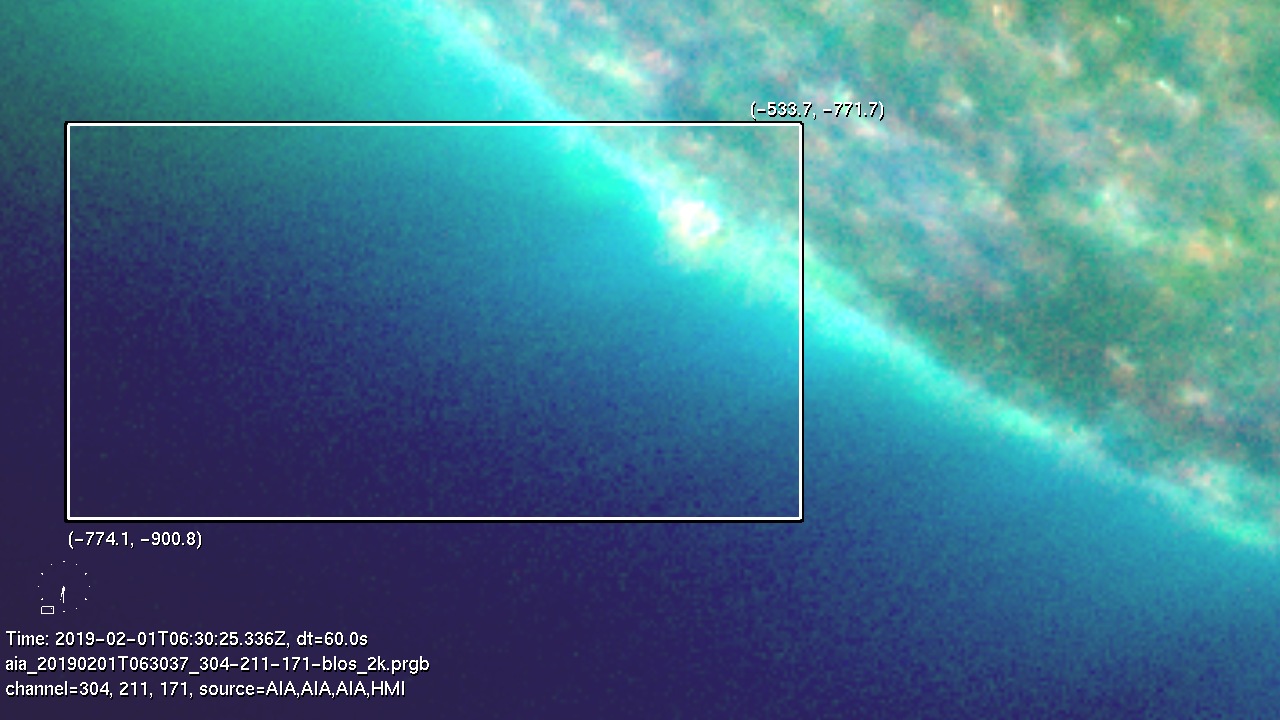
Detected by halocme, Submitted at 2019-02-08T00:16:10
2019-02-01T06:20:25 --> 2019-02-01T07:30:25
An erupting "mini-filament" can be be traced in the low part of the jet.

Detected by Milan Gosic, Submitted at 2019-02-07T19:47:18
2019-02-03T16:29:53 --> 2019-02-03T17:41:05
QS/CH boundary observed for almost 11 hours on 2019/02/03. This observational sequence should coincide with the slit crossing the QS/CH boundary. There are 3 more observational runs before and after this sequence, covering QS, QS/CH boundary and CH.

Detected by Milan Gosic, Submitted at 2019-02-07T19:44:18
2019-02-02T16:09:00 --> 2019-02-02T17:20:12
QS/CH boundary observed for almost 11 hours. This observational sequence should coincide with the slit crossing the QS/CH boundary. There are 3 more observational runs before and after this sequence, covering QS, QS/CH boundary and CH.


Detected by Milan Gosic, Submitted at 2019-02-07T19:38:09
2019-02-01T06:24:52 --> 2019-02-01T07:01:43
Coronal rain along coronal loops above AR 12733 on the west limb. It happened after a microflare. The event is covered by the slit.

Detected by Milan Gosic, Submitted at 2019-02-07T19:29:32
2019-01-31T10:44:18 --> 2019-01-31T11:32:38
Coronal rain above AR 12733 on the west limb, covered by the slit.


Detected by Milan Gosic, Submitted at 2019-02-07T19:24:45
2019-01-31T09:18:38 --> 2019-01-31T09:54:07
Two spray surges on the west limb, covered by the slit (AR 12733).


Detected by halocme, Submitted at 2019-02-07T03:39:13
2019-01-31T17:45:01 --> 2019-01-31T19:25:01
The eruption started at the southern periphery of a plage region. In STEREO-A EUVI images, the region was near the disk center, and the eruption looked like expanding loops.


Detected by halocme, Submitted at 2019-02-07T03:21:47
2019-01-30T05:40:14 --> 2019-01-30T06:59:26
The biggest flare from AR 12733. Like others in the series, the flare was not eruptive despite violent motions in the vicinity of the central flare area.

Detected by halocme, Submitted at 2019-02-07T03:17:06
2019-01-29T21:00:30 --> 2019-01-29T22:50:54
Violent motions were observed after the flare brightening, but not associated with a CME, a similar pattern to the previous C1.9 flare also from AR 12733.

Detected by halocme, Submitted at 2019-02-07T03:11:09
2019-01-29T09:50:26 --> 2019-01-29T11:00:02
Flare in AR 12733. Surge-like motions are noted, just after the flare brightening, but there was no indication that the ejected material reached the coronagraphic heights, such as ~2 Rs.

Detected by halocme, Submitted at 2019-02-07T03:06:23
2019-01-28T14:30:01 --> 2019-01-28T15:40:01
The outward motion of cool material, highly non-radial, propagated to high altitudes. It only resulted in a marginal jet. No type III bursts were associated.

Detected by halocme, Submitted at 2019-02-07T01:36:33
2019-01-27T15:50:25 --> 2019-01-27T16:50:25
This jet involves helical motions of cool material as seen in 304 A images. No type III radio burst is noted in Wind/WAVES data.

Detected by halocme, Submitted at 2019-02-06T23:07:05
2019-01-26T06:00:09 --> 2019-01-26T11:30:09
A diffuse eruption with cool prominence matrial underlying a flux-rope-like outward-moving feature seen only in 171 A images. No CME associated.

Detected by halocme, Submitted at 2019-02-06T22:52:24
2019-01-26T13:00:02 --> 2019-01-26T14:00:02
The largest X-ray flare since 2018 Feb 7. It was non-eruptive, even though signatures were seen that are often thought of as being related to eruptions, such as rising loops and high-temperature regions just above nthe bright flare loops. Flares in AR 12733 were generally non-eruptive.


Detected by gchintzo, Submitted at 2019-02-05T19:14:51
2019-02-04T00:00:09 --> 2019-02-05T15:00:09
A decaying active region of overall bipolar magnetic distribution. This AR is not catalogued by NOAA.


Detected by Chad Madsen, Submitted at 2019-01-31T21:04:17
2019-01-28T19:23:25 --> 2019-01-28T20:22:39
A small, thin, straight, stable prominence protruding from the northeast limb.


Detected by Chad Madsen, Submitted at 2019-01-31T21:01:10
2019-01-28T18:12:24 --> 2019-01-28T18:46:03
Running sunspot waves seen in the FUV SJI channels of IRIS. The ripple-like waves spread throughout the umbra and penumbra of the leading sunspot.


Detected by Chad Madsen, Submitted at 2019-01-31T16:20:03
2019-01-28T09:38:33 --> 2019-01-28T10:26:53
Small, compact brightenings indicative of UV bursts largely near the leading sunspot of AR12733. Also, there is a material flow towards the AR from a trailing network patch.

Detected by Chad Madsen, Submitted at 2019-01-31T16:13:38
2019-01-28T01:31:24 --> 2019-01-28T02:19:44
Small, compact brightenings indicative of UV bursts throughout AR12733.

Detected by Chad Madsen, Submitted at 2019-01-29T21:42:29
2019-01-27T20:57:40 --> 2019-01-27T21:14:57
A jet emanating from an oval-shaped brightening in between patches of plage on the right half of the field-of-view. The event begins with an extended phase of high intensity and then quickly dissipates as material appears exit toward the right edge of the field-of-view.
