Recent Events Reported by Observers
Previous Next
Detected by Kathy Reeves, Submitted at 2018-04-30T17:45:00
2018-04-24T06:28:44 --> 2018-04-24T06:35:11
Slit crosses a sunspot with a nice light bridge


Detected by Jean-Pierre Wuelser, Submitted at 2018-04-25T23:18:11
2018-04-22T06:37:59 --> 2018-04-22T07:04:00
Small surge


Detected by Jean-Pierre Wuelser, Submitted at 2018-04-25T23:12:10
2018-04-21T20:54:56 --> 2018-04-21T21:02:53
Tiny flare (B1.2)

Detected by Jean-Pierre Wuelser, Submitted at 2018-04-25T23:07:58
2018-04-20T16:55:33 --> 2018-04-20T17:10:10
Small flare (B5.4)


Detected by cheung, Submitted at 2018-04-25T21:49:21
2018-04-25T09:20:09 --> 2018-04-25T13:10:09
Repeated filament activations in the core of AR 12706.


Detected by Paul Bryans, Submitted at 2018-04-25T15:46:55
2018-04-03T23:00:26 --> 2018-04-03T23:56:59
Small brightening and perhaps failed eruption on leading polarity of AR 12703.

Detected by Paul Bryans, Submitted at 2018-04-25T15:44:58
2018-04-03T09:52:00 --> 2018-04-03T10:15:17
Activation of filament channel along the PIL of AR 12703.


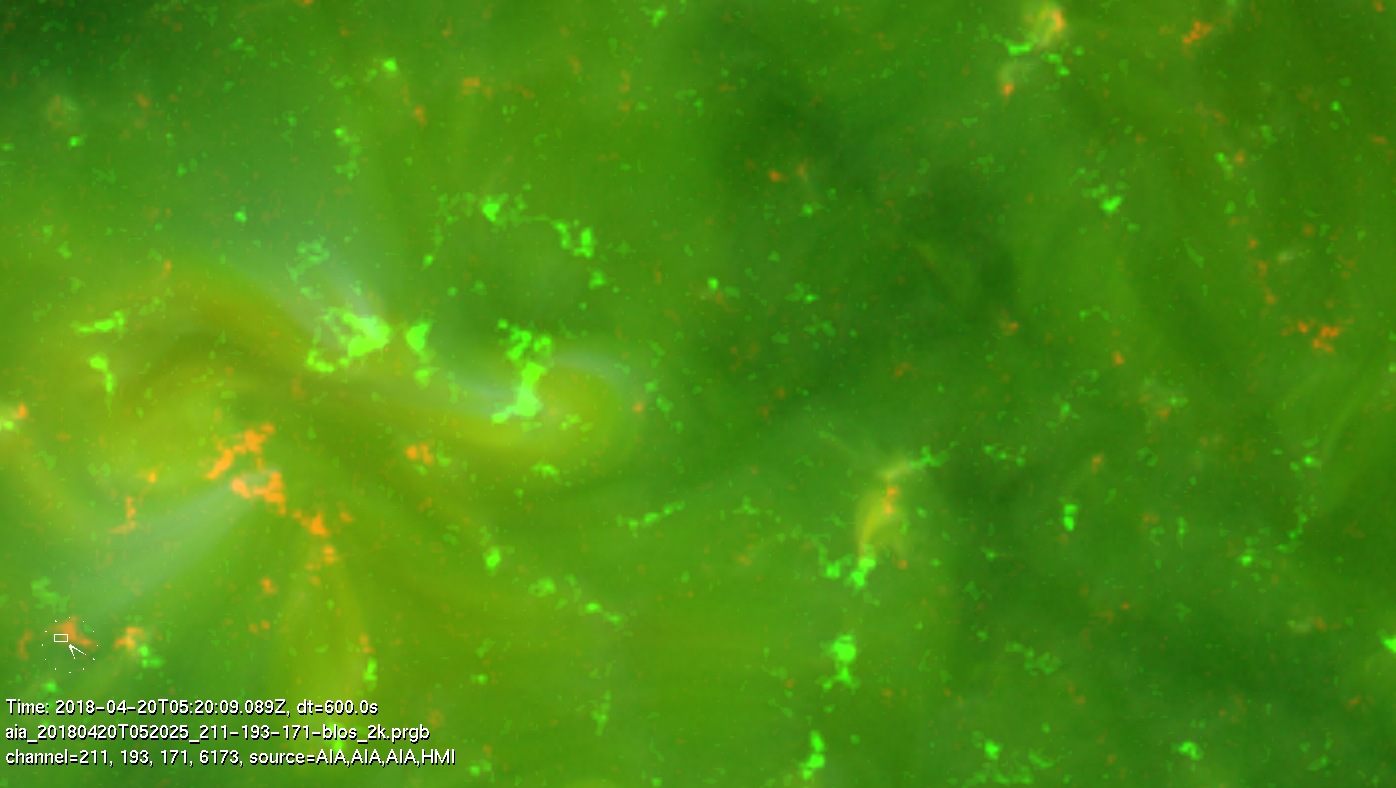
Detected by tiwari, Submitted at 2018-04-23T18:10:20
2018-04-20T04:50:09 --> 2018-04-21T03:30:09
A small filament erupts as a result of flux cancellation. The flux cancellation continues after the event.

Detected by tiwari, Submitted at 2018-04-20T18:27:35
2018-04-19T00:00:09 --> 2018-04-20T01:40:09
Flux cancellation leading to several small-scale jet-like eruptions in a coronal hole.


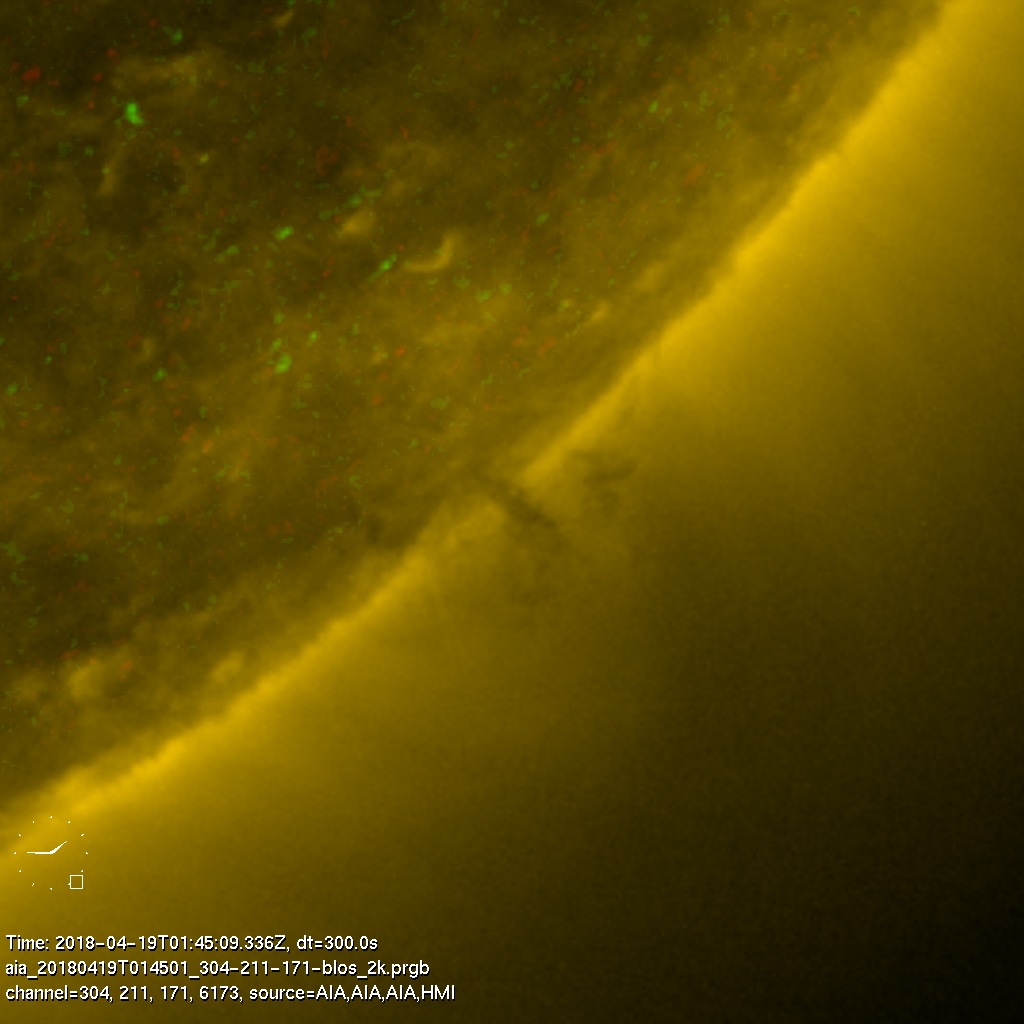
Detected by tiwari, Submitted at 2018-04-20T18:03:49
2018-04-19T00:00:09 --> 2018-04-20T05:00:09
A small prominence tornado inside a coronal cavity.

Detected by tiwari, Submitted at 2018-04-20T18:03:48
2018-04-19T00:00:09 --> 2018-04-20T05:00:09
A small prominence tornado inside a coronal cavity.
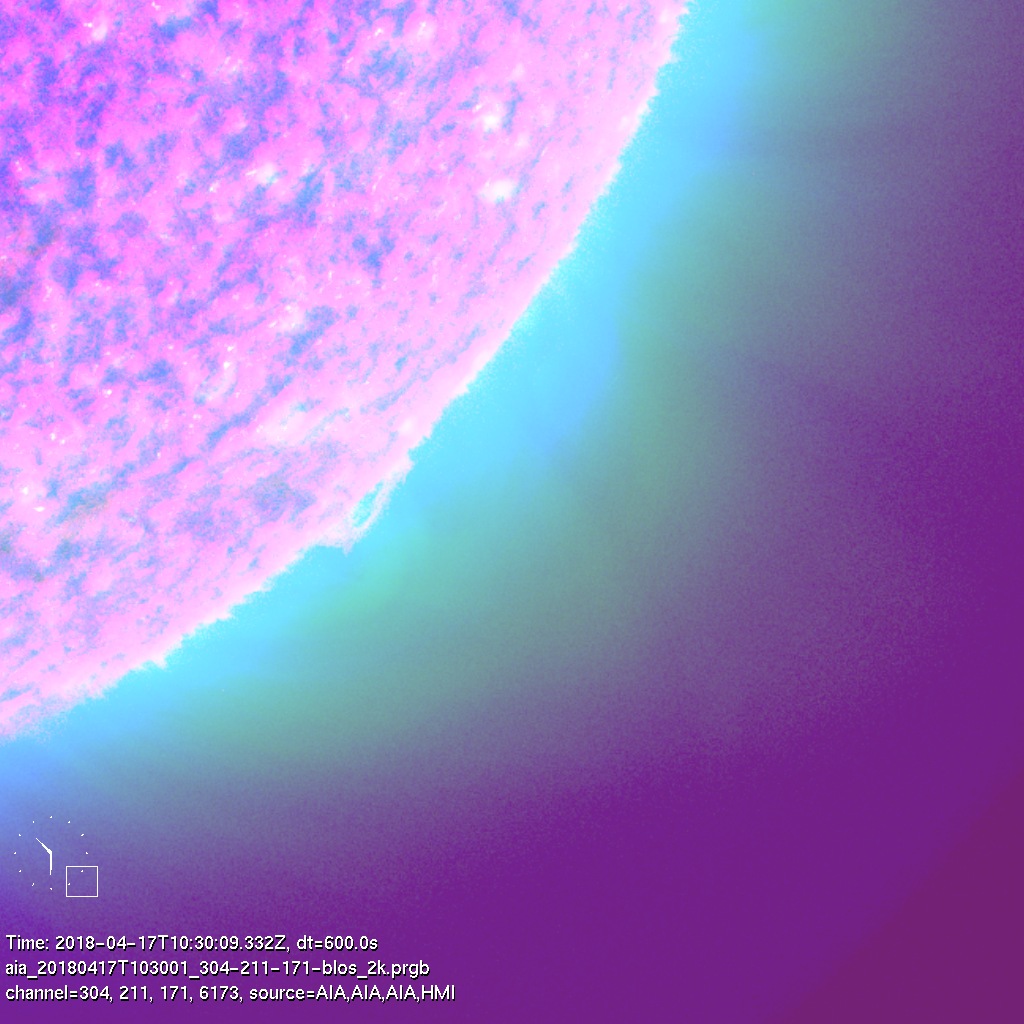
Detected by gchintzo, Submitted at 2018-04-17T23:52:35
2018-04-17T00:00:09 --> 2018-04-17T20:10:09
A filament erupting in the southwest quadrant of the solar disk. A narrow angle CME was associated with this event (http://spaceweather.gmu.edu/seeds/mkmovie.php?cme=20180417.072424.w122.v0404.p159&frame=4&r&cor2=a)

Detected by gchintzo, Submitted at 2018-04-17T23:43:13
2018-04-14T10:40:09 --> 2018-04-15T15:00:09
An ephemeral region emerging in the southwest quadrant of the sun. Green colors show high temperatures of 2 MK.

Detected by gchintzo, Submitted at 2018-04-17T23:33:14
2018-04-14T10:40:09 --> 2018-04-15T15:00:09
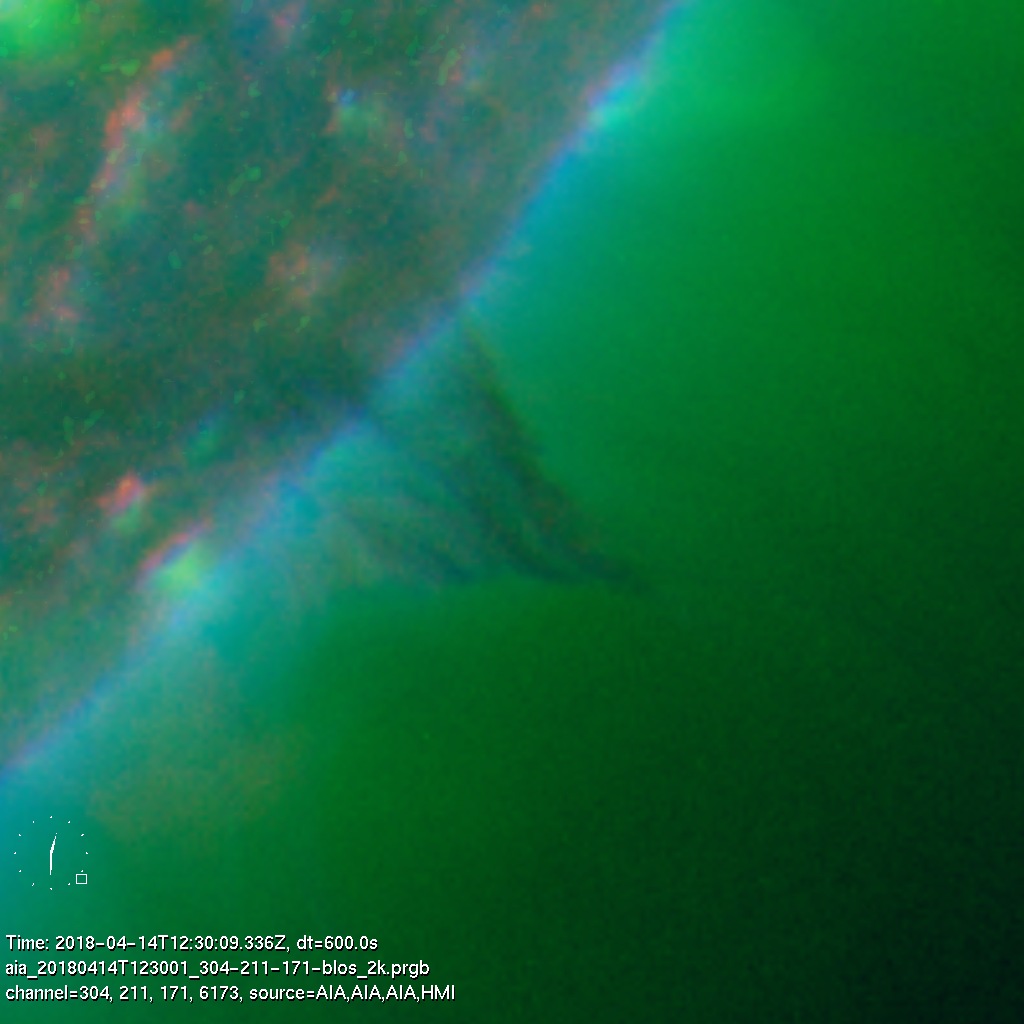
A solar prominence (dark material) suspended in a coronal cavity. Here, the "envelope" of the the highest lying parts of the prominence mark the lower side of a coronal cavity.
Detected by gchintzo, Submitted at 2018-04-17T22:17:47
2018-04-14T10:40:09 --> 2018-04-15T15:00:09
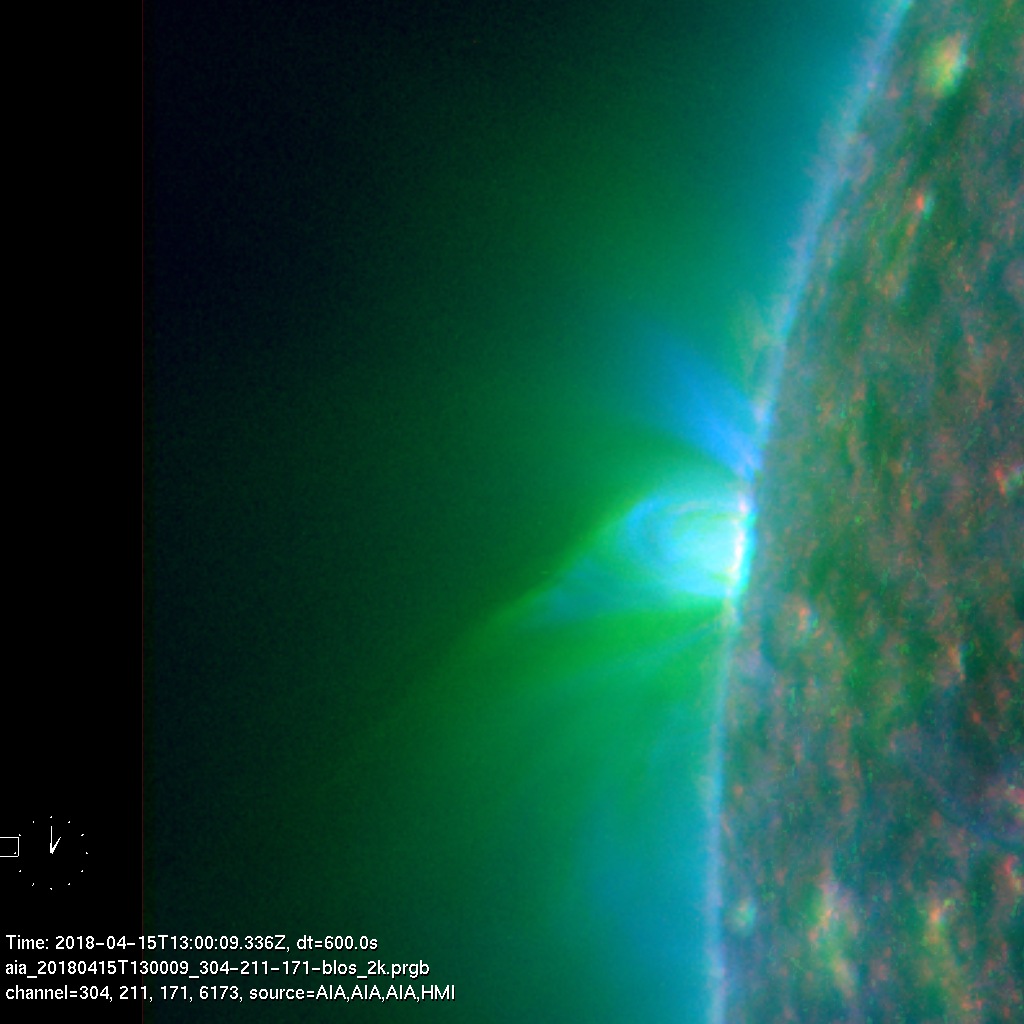
Three narrow-angle eruptions from a back-sided AR. (2018/04/14 20:00 UT: 200 km/s; http://spaceweather.gmu.edu/seeds/dailymkmovie.php?cme=20180414&r 2018/04/15 00:48 UT: 162 km/s;http://spaceweather.gmu.edu/seeds/mkmovie.php?cme=20180415.004807.w033.v0162.p089&frame=6&r (2018/04/15 05:48 UT: 326 km/s;http://spaceweather.gmu.edu/seeds/mkmovie.php?cme=20180415.054807.w036.v0326.p092&frame=16&r)
Detected by gchintzo, Submitted at 2018-04-17T18:02:41
2018-04-14T06:20:09 --> 2018-04-15T10:40:09
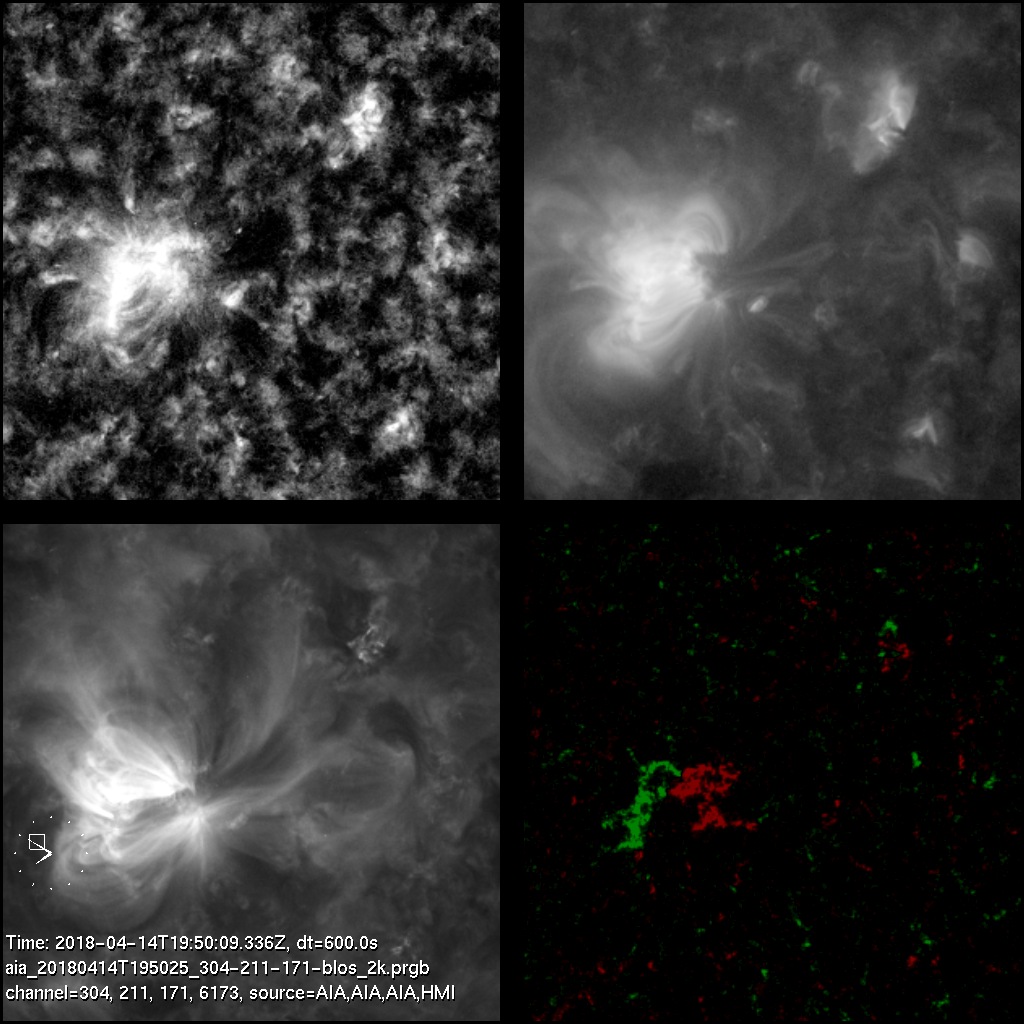
A decaying active region in the northeast quadrant of the solar disk as seen in three different wavelengths (304 A: T=50kK; 171 A: T=0.6 MK; 211 A: T=2 MK). Note the magnetic flux distribution on the surface (green positive, red negative flux). A filament is seen as a dark feature in 304 A (diffuse s-shaped feature; top left panel).

Detected by Jacob Parker, Submitted at 2018-04-16T15:49:47
2018-04-10T16:41:24 --> 2018-04-10T17:23:32
Small surge with material visible above the west limb. Slit catches both the eruption and material above the limb.

Detected by gchintzo, Submitted at 2018-04-13T21:10:41
2018-04-12T00:00:09 --> 2018-04-12T04:47:39
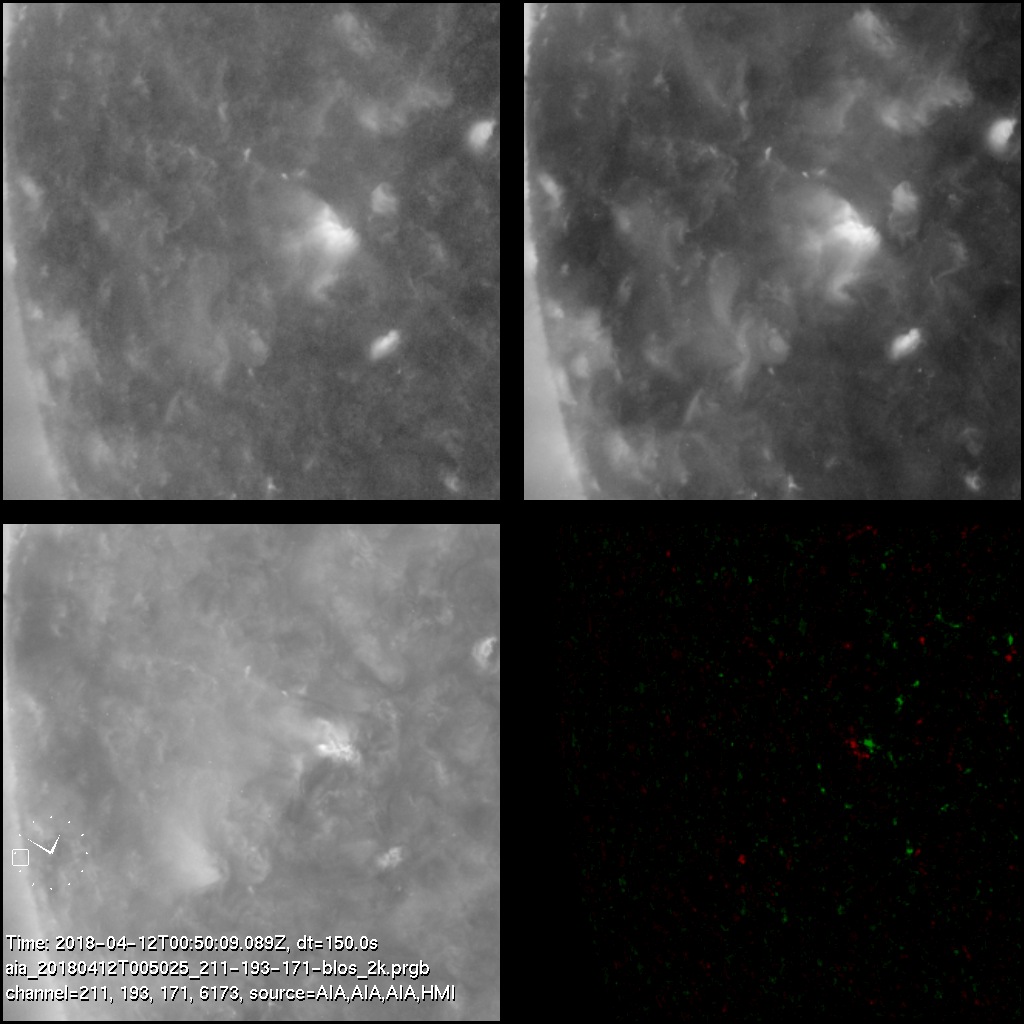
A minifilament eruption on the southeast quadrant of the solar disk (solar limb on the left). The interesting thing here is that there seems to be a shock bubble associated with this eruption.
Detected by gchintzo, Submitted at 2018-04-11T22:34:15
2018-04-10T00:00:09 --> 2018-04-10T13:40:09
Same as previously, but in a four panel view separating the wavelengths.

Detected by gchintzo, Submitted at 2018-04-11T22:03:41
2018-04-10T00:00:09 --> 2018-04-10T13:40:09
Recurrent eruptions (three?) near the solar disk center that seems to be associated with cancelling magnetic features on the surface (red and green structures)