Recent Events Reported by Observers
Previous Next
Detected by halocme, Submitted at 2017-02-27T06:39:32
2017-02-20T15:30:01 --> 2017-02-20T16:40:01
Although it is not clear whether the mini-filament acually erupted, a post-eruption arcade was clearly observed.

Detected by halocme, Submitted at 2017-02-27T06:34:55
2017-02-20T14:00:09 --> 2017-02-20T20:00:09
This eruption seemed to involve a wide longitude just behind the limb on the basis of the EUVI-A images. It resulted in a narrow CME as in http://spaceweather.gmu.edu/seeds/mkmovie.php?cme=20170220.182407.w025.v0179.p058&frame=22&r.

Detected by gchintzo, Submitted at 2017-02-20T23:11:11
2017-02-18T17:40:09 --> 2017-02-20T00:40:09
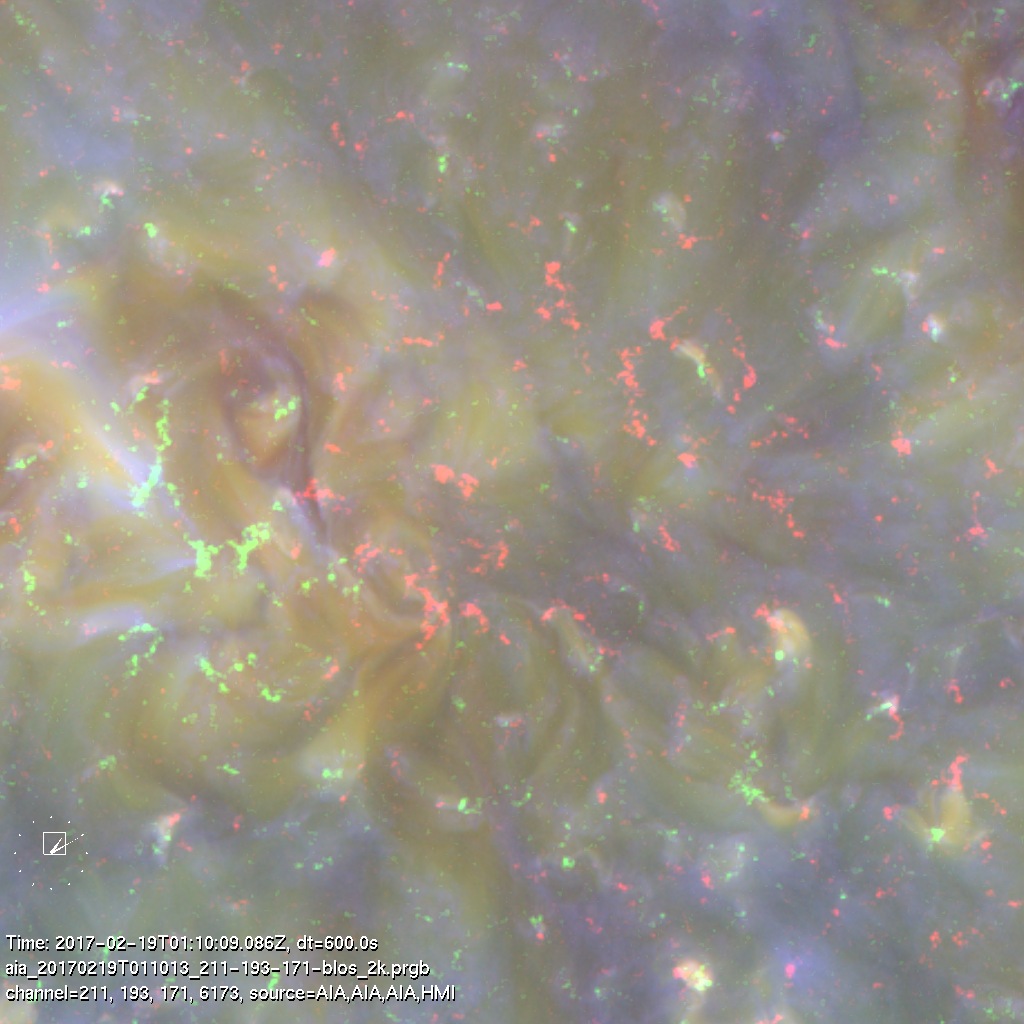
A hook-shaped filament formed above a decaying Active Region (red: negative, green: positive line-of-sight magnetic field saturated at |B|=250 G). This eruption does not seem to be associated with a CME (based on LASCO observations). The brief darkening of the movie occurs due to SDO's eclipse season (FOV occulted by Earth).

Detected by gchintzo, Submitted at 2017-02-20T22:59:30
2017-02-17T17:40:09 --> 2017-02-18T17:00:09
Tri-color movie (red: 211 A, green: 193 A, blue: 171 A) centered at the North East solar limb showing a narrow angle eruption in different wavelengths. This eruption is the source of a slow (200 km / sec) narrow-angle (jet-like) CME observed by LASCO (see http://spaceweather.gmu.edu/seeds/mkmovie.php?cme=20170218.012522.w032.v0168.p063&frame=16&r) The Eruption occurs a few hours after another jet-like CME eruption from the same source region. The CME quickly overtakes the prior eruption.

Detected by gchintzo, Submitted at 2017-02-20T22:22:21
2017-02-17T07:00:09 --> 2017-02-17T20:00:09
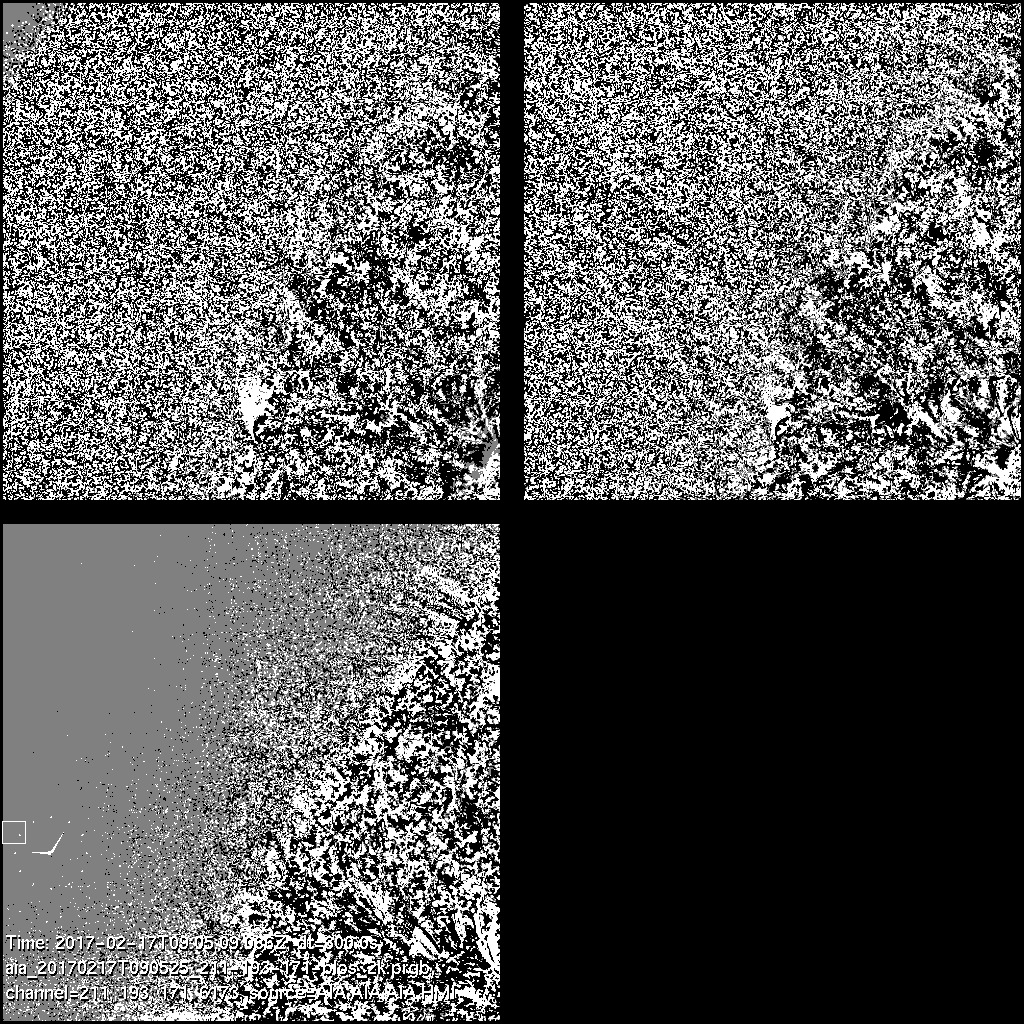
Running difference movie showing the North East solar limb showing a narrow angle eruption in different wavelengths. This eruption is the source of a slow (200 km / sec) narrow-angle (jet-like) CME observed by LASCO (see http://spaceweather.gmu.edu/seeds/mkmovie.php?cme=20170217.152409.w023.v0205.p059&frame=18&r)

Detected by Jakub Prchlik, Submitted at 2017-02-15T20:19:55
2017-02-01T19:51:15 --> 2017-02-01T20:16:14
IRIS observes a microflare in AR 12629. While the flare is faint, its evolution is dynamic. Initially, the flare's intensity occupies a narrow bad. However, after a few minutes the flare's intensity forms a X morphology before fading away.


Detected by Jakub Prchlik, Submitted at 2017-02-15T20:11:06
2017-02-06T16:50:45 --> 2017-02-06T17:48:51
IRIS captures emerging flux east of AR 12632 during a DST coordination. The slit captures the emergence, so its spectrum may be interesting for researchers interested in flux emergence.


Detected by Jakub Prchlik, Submitted at 2017-02-15T20:01:45
2017-02-05T16:21:25 --> 2017-02-05T16:30:27
During a DST coordination, IRIS observes a coronal jet in AR 12632. The jet forms a clear narrow spire with a standard semi-torodial base.

Detected by Jakub Prchlik, Submitted at 2017-02-15T19:49:02
2017-02-04T22:51:12 --> 2017-02-04T23:07:38
IRIS observes a microflare in AR 12629 on the W-limb. The flares rapidly changes morphology from bulbous to arch-like.


Detected by Jakub Prchlik, Submitted at 2017-02-15T19:42:06
2017-02-04T01:14:32 --> 2017-02-04T02:07:23
Deep exposures of AR 12629 show coronal rain, which is easily visible in 1330 and 1400.

Detected by Jakub Prchlik, Submitted at 2017-02-15T19:36:29
2017-02-02T15:31:58 --> 2017-02-02T15:40:21
During a DST coordination, IRIS observes a microflare. While the event is dim, it crosses the slit during a sit and stare observation. Therefore, the observed spectral line evolution is only temporal evolution.

Detected by Jakub Prchlik, Submitted at 2017-02-15T19:27:16
2017-02-02T12:45:49 --> 2017-02-02T13:02:36
IRIS observes a microflare in AR 12629. The flare noticeably brightens in 1330 and 1400. The slit captures the flare during its initiation.

Detected by Jakub Prchlik, Submitted at 2017-02-15T19:16:25
2017-02-01T00:20:47 --> 2017-02-01T01:09:09
During a coordinated SOT observation, IRIS observes a presentine coronal jet. The jet activates twice during the observation. The first activation shows a clear spire and a broad base, while the second jet is nebulous. Both 1330 and 1400 clearly show the jet activate twice, but 2796 also shows brightening during the jet's activation.

Detected by Jakub Prchlik, Submitted at 2017-02-15T19:06:35
2017-01-31T17:48:00 --> 2017-01-31T18:44:09
During a coordinated DST observation, IRIS observes a coronal jet in AR 12629. The jet possesses a bright base, which is visible in 1330 and 2796. However, only 1330 shows the long, faint spire.

Detected by Tiago Pereira, Submitted at 2017-02-14T17:07:22
2017-02-12T22:16:43 --> 2017-02-12T22:44:43
Small flaring region (ribbon seen) on AR12635.

Detected by Tiago Pereira, Submitted at 2017-02-14T16:52:10
2017-02-11T13:46:17 --> 2017-02-11T14:08:22
Large coronal jet near the decaying AR12630.

Detected by Tiago Pereira, Submitted at 2017-02-14T16:49:57
2017-02-11T12:49:21 --> 2017-02-11T13:05:08
Large coronal jet on West limb, near the decaying AR12630.

Detected by Tiago Pereira, Submitted at 2017-02-14T16:43:21
2017-02-10T20:12:11 --> 2017-02-10T20:14:40
Small flaring region (ribbon?) see in AR12635.

Detected by Tiago Pereira, Submitted at 2017-02-14T11:35:19
2017-02-09T18:16:22 --> 2017-02-09T18:47:10
A wide jet coming off from an unnamed AR near West limb. AR very bright at the limb, and coronal rain also seen. Largest loops off the AR have a flat top.


Detected by gchintzo, Submitted at 2017-02-14T00:27:09
2017-02-12T12:00:09 --> 2017-02-13T16:00:09
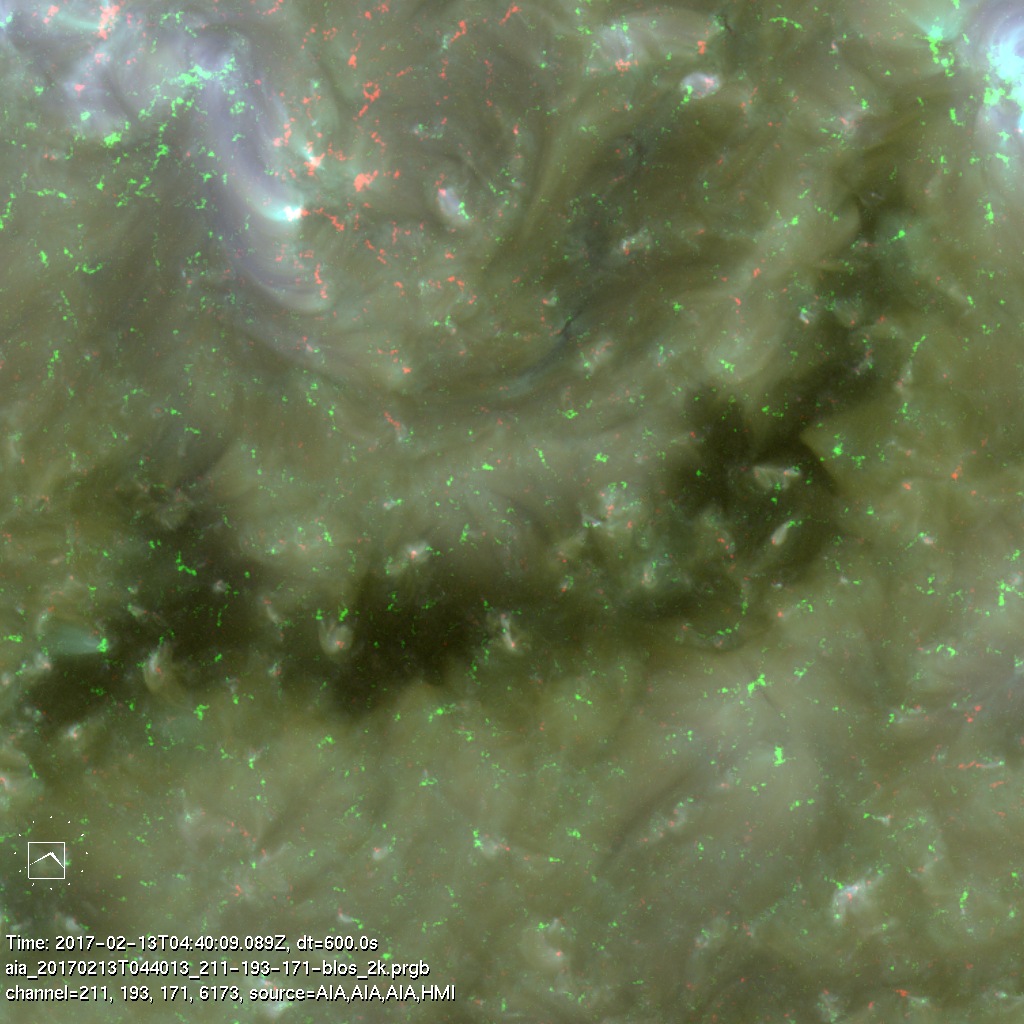
A narrow, trans-equatorial coronal hole. Coronal holes are predominantly unipolar regions (here, green positive magnetic field, red negative magnetic field). Note the significant amount of activity within the coronal hole, primarily at locations where 'parasitic' negative patches exist (red color). Each negative patch seems to be connected to a nearby positive patch; several of these ad-hoc bipoles seem to host mini-sigmoids in the corona, which some of those mini-sigmoids erupt/interact with neighboring ones.