
Recent Events Reported by Observers
Previous Next
Detected by anny, Submitted at 2014-02-11T03:40:13
2014-02-06T03:32:03 --> 2014-02-06T05:44:03
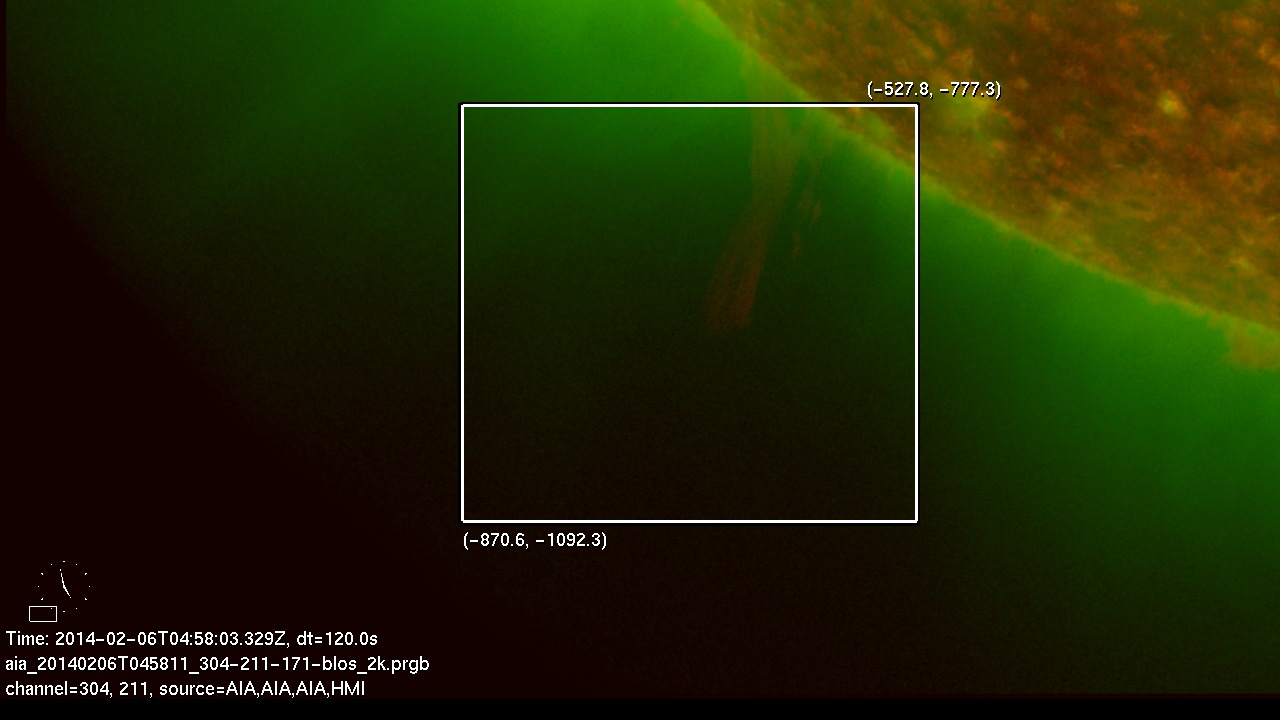
A small cavity eruption on the SE limb, with an associated faint flux rope eruption.

Detected by anny, Submitted at 2014-02-11T03:40:11
2014-02-06T03:32:03 --> 2014-02-06T05:44:03
A small cavity eruption on the SE limb, with an associated faint flux rope eruption.

Detected by derosa, Submitted at 2014-02-08T00:05:14
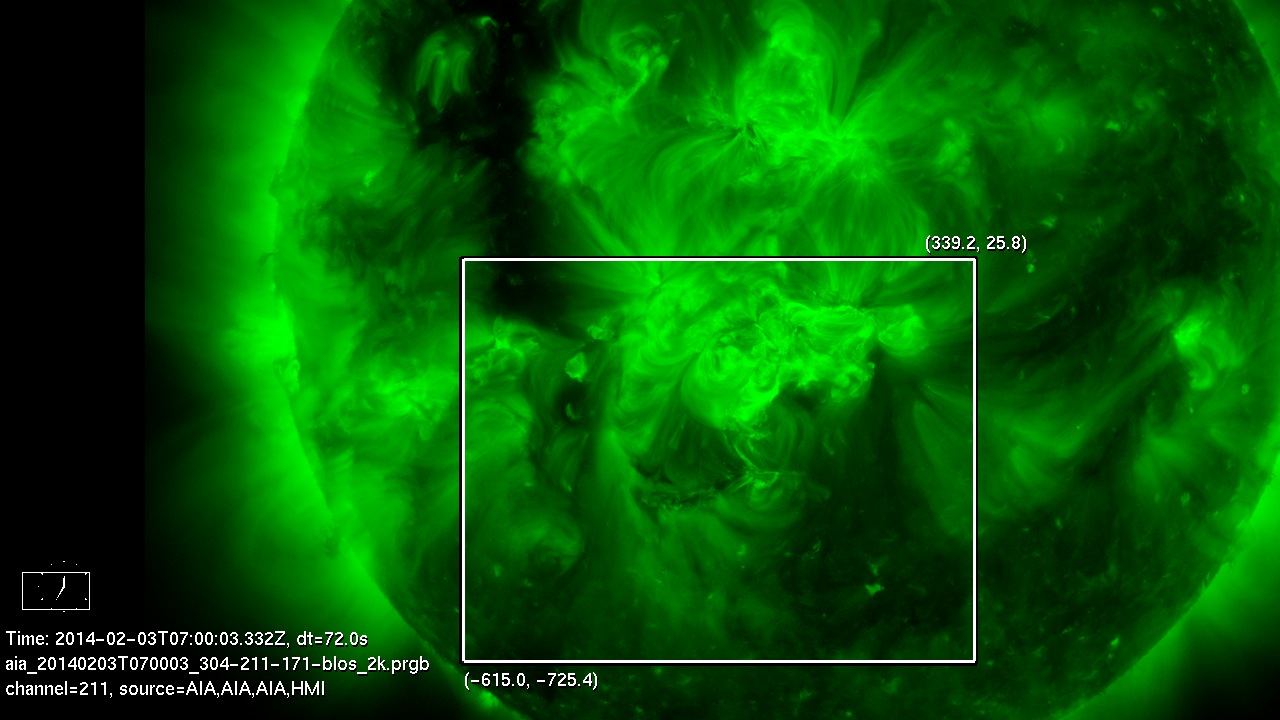
2014-02-03T04:00:03 --> 2014-02-03T11:00:03
Formation of a coronal hole extension as seen in the AIA 211 channel. A filament activation associated with AR 11967 causes enough of a reconfiguration of the overlying magnetic field that allows the hotter and denser plasma southeast of the active region to evacuate. The region goes dark shortly after the filament activation occurs.
Detected by anny, Submitted at 2014-02-05T02:26:33
2014-01-30T13:14:03 --> 2014-01-30T17:18:03
The Earth transit has clearly caused the large filament to erupt producing an EUV wave. The preceding M6.6 flare is purely coincidental.


Detected by anny, Submitted at 2014-02-05T02:26:32
2014-01-30T13:14:03 --> 2014-01-30T17:18:03
The Earth transit has clearly caused the large filament to erupt producing an EUV wave. The preceding M6.6 flare is purely coincidental.
Detected by anny, Submitted at 2014-02-05T02:02:20
2014-01-29T00:00:03 --> 2014-01-29T03:08:03
An explosive activity in one filament is immediately followed by eruption of a nearby larger filament.


Detected by anny, Submitted at 2014-02-05T01:46:59
2014-01-28T00:00:03 --> 2014-01-29T00:00:03
A lot seems to be going on in this remarkable active region over the last several days. Right now, it is positioned right at the E limb which might make it a favorable subject of future studies.


Detected by anny, Submitted at 2014-02-05T01:40:24
2014-01-28T15:08:03 --> 2014-01-29T00:00:03
A large prominence detatches on one end and slowly contracts towards the other end.


Detected by anny, Submitted at 2014-02-05T01:37:12
2014-01-28T03:48:03 --> 2014-01-28T10:18:03
A C9-class flare is immediately followed by coronal rain formation above the site of the flare, on the E limb. The massive spray surge erupts from visually where the rain has fallen down, immediately after it's done falling.


Detected by anny, Submitted at 2014-02-05T01:37:11
2014-01-28T03:48:03 --> 2014-01-28T10:18:03
A C9-class flare is immediately followed by coronal rain formation above the site of the flare, on the E limb. The massive spray surge erupts from visually where the rain has fallen down, immediately after it's done falling.
Detected by anny, Submitted at 2014-02-05T01:12:32
2014-01-28T00:44:03 --> 2014-01-28T06:12:03
A thn long twisted strand slowly raises above the surface at a SW limb. As it disappears, some of the material appears to take off the FOV.

Detected by halocme, Submitted at 2014-02-03T15:38:29
2014-01-30T21:00:35 --> 2014-02-03T03:00:35
From 31 Jan through 2 Feb, the visible side of the Sun showed a big active region AR 1967 in the souther hemisphere coming toward central meridian. In addition, another region AR 1968 was seen in the norther hemisphere. Together there were 10 M-class flares. Every time an intense flare occurred in one of these regions, space weather fans wishfully thought they would launch a CME that could affect the heliosphere. This seemed to be all wrong, however. It is true that a CME can be harder to see if it arises from a region close to disk center, but the appearance of the associated coronal dimming indicates that the flares from AR 1967 or 1968 were not associated with major CMEs. Perhaps these regions were embedded in strong magnetic field environment. The trans-equatorial loops between them also seemed to be quite stable. During this period CMEs were mostly from backside regions occasionally producing clear dimming over the southwest limb and marginal dimming over the east limb. The CME source identification has been done using STEREO data.

Detected by anny, Submitted at 2014-02-01T02:57:56
2014-01-27T00:00:03 --> 2014-01-27T00:57:03
I'd like to call it an EUV wave, except for (a) it's at the S limb, (b) it shows in 304A but not in 171A and 211A. Perhaps, remnants of some erupted flux rope passed by?


Detected by anny, Submitted at 2014-02-01T02:54:30
2014-01-27T00:00:03 --> 2014-01-27T06:00:03
A rapid oscillation of loop tops in 171A. The oscillations last for quite a few periods before getting damped.

Detected by anny, Submitted at 2014-02-01T02:51:10
2014-01-27T17:24:03 --> 2014-01-27T23:42:03
A sequence of rapid surges at the W limb.

Detected by anny, Submitted at 2014-02-01T02:49:30
2014-01-27T10:33:03 --> 2014-01-27T17:51:03
A large short-lived prominence, perhaps a part of the filament at the top of the selected ROI.

Detected by anny, Submitted at 2014-02-01T00:44:27
2014-01-27T00:00:03 --> 2014-01-28T00:00:03
A gorgeous ensemble of coronal loops on the E limb. A textbook-quality illustration of what loops are, demonstrating a good variety of loops' appearance and disappearance, evolution, oscillations, and so on.


Detected by anny, Submitted at 2014-02-01T00:38:48
2014-01-27T19:30:03 --> 2014-01-27T23:21:03
A transient coronal dimming, perhaps associated with an eruption, with a peculiar configuration of the "post-eruption" loops in the QS.

Detected by anny, Submitted at 2014-02-01T00:33:38
2014-01-26T00:00:03 --> 2014-01-27T00:00:03
Something is constantly erupting behind the SE limb. Most of the eruptions are weak and are more obvious iin 211A running differences. What is going on up there? We will soon find out, as whatever is erupting over there rotates towards us right now

Detected by anny, Submitted at 2014-02-01T00:26:31
2014-01-26T20:24:03 --> 2014-01-27T00:00:03
A large prominence eruption, visually originating behind the SE limb. Note a handful of fine-scale 171A "grains of sand" expelled (visually between the two main footpoints).
