
Recent Events Reported by Observers
Previous Next
Detected by schryver, Submitted at 2014-10-14T22:17:50
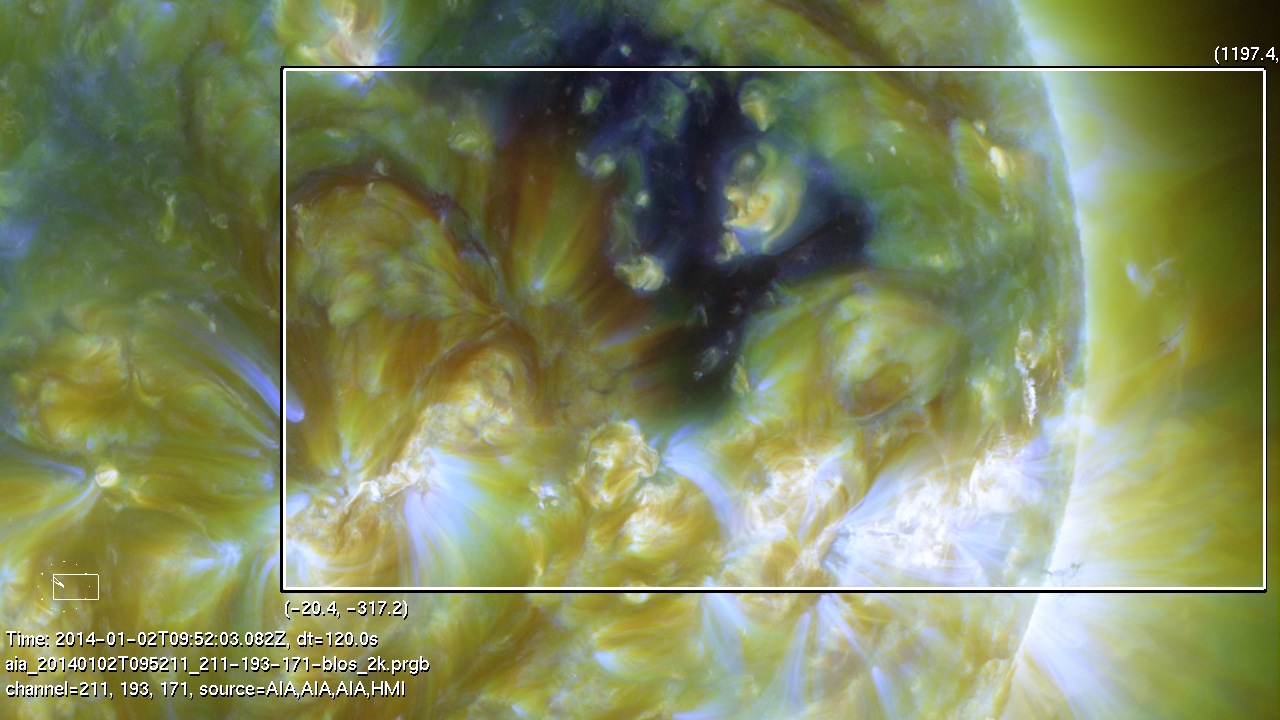
2014-01-02T09:04:03 --> 2014-01-02T11:32:03
A near-equatorial QS filament erupts from near the W limb. Synchronously, an AR filament near DC activates, as does a filament SE of the primary eruption. A fragment of a prominence to the S of the eruption exhibits briefly oscillations.

Detected by schryver, Submitted at 2014-10-14T22:17:31
2014-01-02T09:04:03 --> 2014-01-02T11:32:03
A near-equatorial QS filament erupts from near the W limb. Synchronously, an AR filament near DC activates, as does a filament SE of the primary eruption. A fragment of a prominence to the S of the eruption exhibits briefly oscillations.
Detected by schryver, Submitted at 2014-10-14T22:17:50
2014-01-02T03:32:03 --> 2014-01-02T12:04:03
Quiet-Sun filament eruption with post-eruption arcade. The filament connects to, and largely falls back to, near to what appears to be the S polar cap boundary. No CME is suggested from AIA observations

Detected by schryver, Submitted at 2014-10-14T22:17:50
2014-01-01T18:00:03 --> 2014-01-02T04:16:03
QS filament eruption

Detected by schryver, Submitted at 2014-10-14T22:17:50
2014-01-01T08:12:03 --> 2014-01-01T16:32:03
Prominence eruption over the SE limb.

Detected by schryver, Submitted at 2014-10-14T22:17:31
2014-01-01T01:08:03 --> 2014-01-01T03:40:03
Filament activation


Detected by schryver, Submitted at 2014-10-14T22:18:03
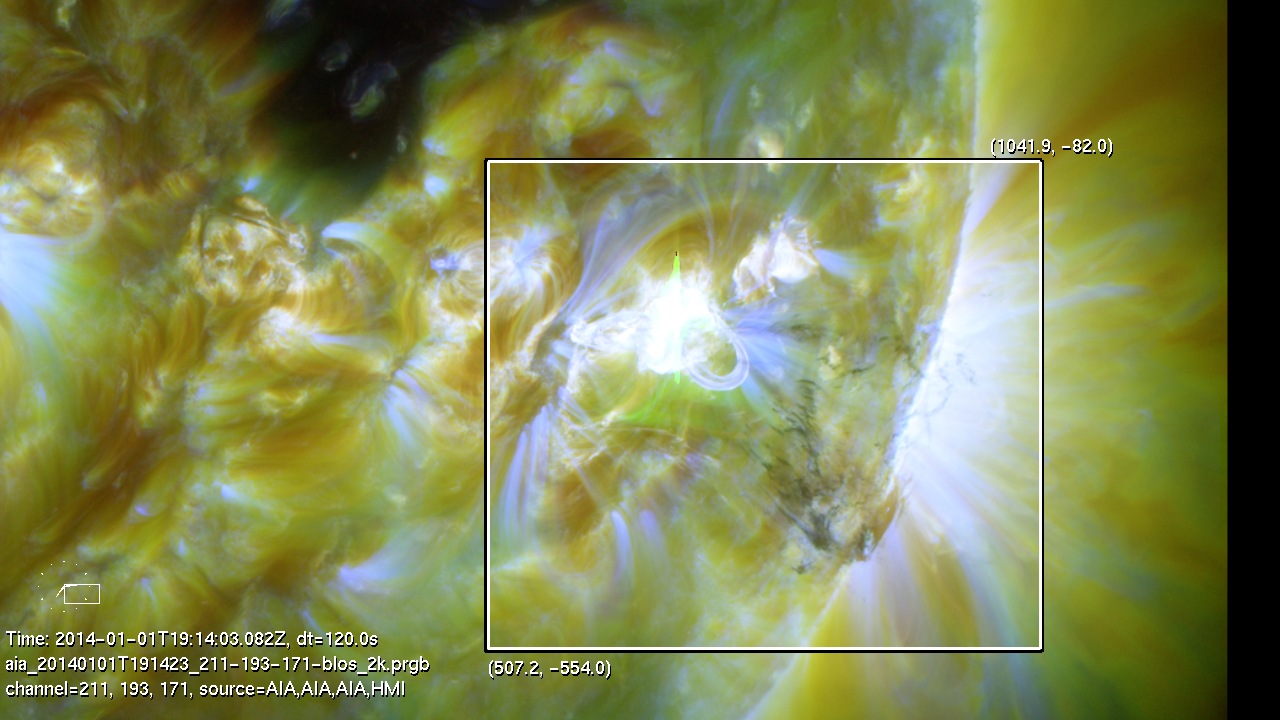
2014-01-01T18:28:03 --> 2014-01-01T21:04:03
An M9 flare from a region in the SW quadrant associated with a filament eruption, with much (most?) of the material falling back onto the surface.
Detected by schryver, Submitted at 2014-10-14T22:17:50
2014-01-01T18:28:03 --> 2014-01-01T21:04:03
An M9 flare from a region in the SW quadrant associated with a filament eruption, with much (most?) of the material falling back onto the surface.
Detected by halocme, Submitted at 2014-01-02T20:25:30
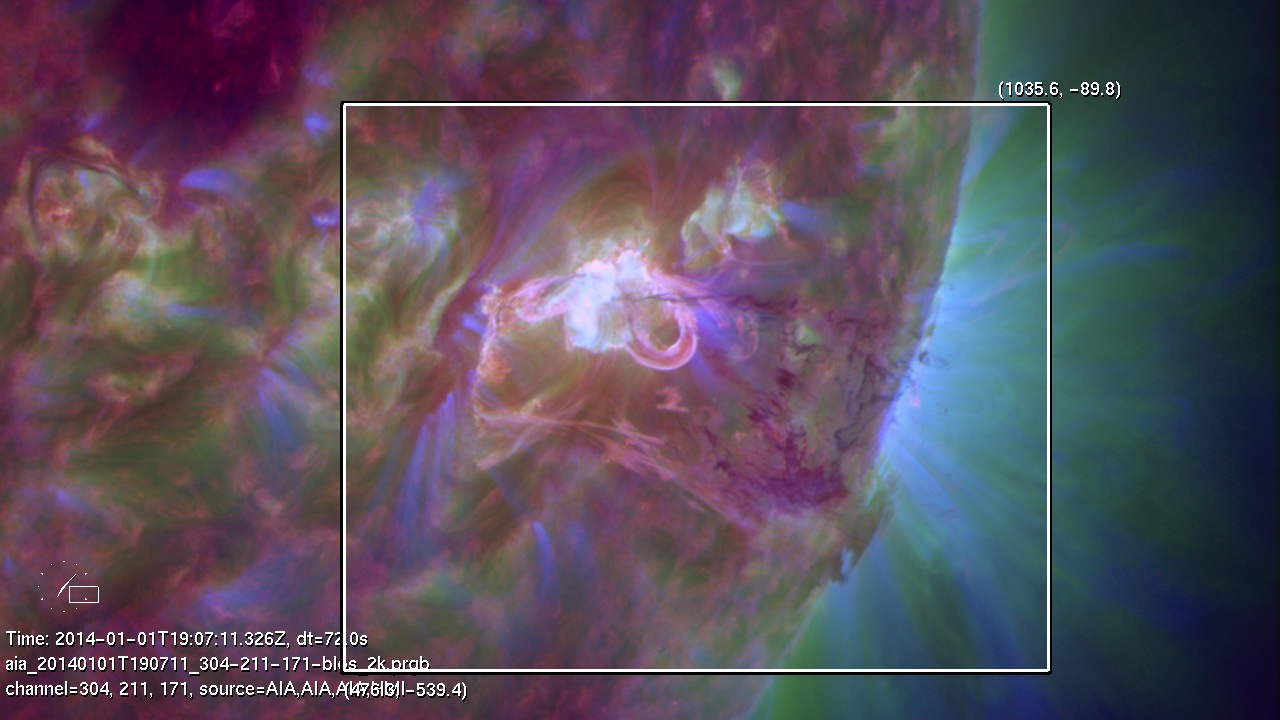
2014-01-01T18:20:23 --> 2014-01-01T19:40:47
This flare is quite similar to the last major (M6.4) flare in 2013 from the same region (AR 11936). Although the way the filament erupted was spectacular because they looked fragmented, it was almost a failed eruption. Most of the stuff came back. The associated CMEs were wimpy at best. The CME associated with the M9.9 flare was a little more decent than that with the M6.4 flare partly because of its location closer to the limb and possibly larger energy released.
Detected by halocme, Submitted at 2014-01-02T20:25:30
2014-01-01T18:20:23 --> 2014-01-01T19:40:47
This flare is quite similar to the last major (M6.4) flare in 2013 from the same region (AR 11936). Although the way the filament erupted was spectacular because they looked fragmented, it was almost a failed eruption. Most of the stuff came back. The associated CMEs were wimpy at best. The CME associated with the M9.9 flare was a little more decent than that with the M6.4 flare partly because of its location closer to the limb and possibly larger energy released.

Detected by schryver, Submitted at 2014-10-14T22:16:27
2013-12-26T02:24:03 --> 2013-12-26T09:52:03
A small bipole emerges next to a large sunspot into an apparent open-flux region, leading to multiple jets.


Detected by schryver, Submitted at 2014-10-14T22:16:23
2013-12-26T02:24:03 --> 2013-12-26T09:52:03
A small bipole emerges next to a large sunspot into an apparent open-flux region, leading to multiple jets.
Detected by schryver, Submitted at 2014-10-14T22:17:31
2013-12-26T05:12:03 --> 2013-12-26T07:44:03
A filament configuration to the S of a S-hemisphere AR activates. It appears as if two segmetns are involve: one (trailing) with a clear dark filament, and one (leading) what looks like a filament configuration in 171 but has not or little absorbing material. The activation starts in the central portion, with ribbons, then appears to proceed along much of the overall configuration in both directions.


Detected by schryver, Submitted at 2014-10-14T22:17:02
2013-12-26T13:48:03 --> 2013-12-26T19:48:03
An eruption occurs from a moderate, decayed AR in the SW quadrant. A pronounced post-eruption arcade forms after ribbons, but no filament/absorbing material is visible before or during the eruption.

Detected by halocme, Submitted at 2014-01-01T02:34:42
2013-12-31T21:00:35 --> 2013-12-31T23:00:35
This M6.4 flare does not look like fully successful sending coronal plasma to interplanetary space, although no LASCO data are available yet to confirm it. The ejected material is seen to largely fall back and there are hardly large-scale disturbances. The motions give an impression of counter-clockwise rotation.

Detected by halocme, Submitted at 2014-01-01T02:34:42
2013-12-31T21:00:35 --> 2013-12-31T23:00:35
This M6.4 flare does not look like fully successful sending coronal plasma to interplanetary space, although no LASCO data are available yet to confirm it. The ejected material is seen to largely fall back and there are hardly large-scale disturbances. The motions give an impression of counter-clockwise rotation.
Detected by halocme, Submitted at 2013-12-31T19:18:23
2013-12-31T10:10:12 --> 2013-12-31T11:59:24
This coronal dimming is associated with a bright CME first seen at 10:36 (marginal) or 10:48. The source region of the eruption was slightly behind the limb; if it had been far behind the limb the associated flare (C8.9) would not have been observed. Is this the last big event in 2013 with 12 hours remaining?


Detected by halocme, Submitted at 2013-12-31T19:18:22
2013-12-31T10:10:12 --> 2013-12-31T11:59:24
This coronal dimming is associated with a bright CME first seen at 10:36 (marginal) or 10:48. The source region of the eruption was slightly behind the limb; if it had been far behind the limb the associated flare (C8.9) would not have been observed. Is this the last big event in 2013 with 12 hours remaining?
Detected by halocme, Submitted at 2013-12-30T01:26:05
2013-12-14T06:20:23 --> 2013-12-14T07:10:23
According to EUVI on STEREO-B, a flare occurred around 2013/12/14 06:10 at S16E137 from Earth view. It was probably only a M-class flare and the eruption in EUVI images was not global. However, AIA clearly saw the eruption. This was presumably because the eruption was largely toward west. A bright, although not wide, CME was associated (06:36 UT by LASCO C2), and a one-minute-long type II burst was reported from Learmonth.

Detected by halocme, Submitted at 2013-12-29T19:29:44
2013-12-29T03:00:03 --> 2013-12-29T10:00:03
A fat, slow, flux-rope CME was seen by LASCO (central position angle of 140 deg) at 06:36 UT or even before, and its source region is arguably behind the east limb. The running difference movie shows an eruption near the SE limb (S12E50), starting around 03:30 and taking off around 04:20 UT. But the off-limb outward motions later (06:30'ish) may be more closely linked to the CME. In order for both AIA and EUVI-B (at 150 behind the Sun-Earth line, only beacon data at 09:06 is available for now after 00:06) to detect them over the east and west limb, respectively, the source region is probably 30 degrees or so beind the limb. Life would have been much easier if STEREO had remained in quadrature with the Earth.
